
What to Buy in Marrakech: 20 Authentic Moroccan Souvenirs
Wondering what to buy in Marrakech? No visit to Marrakech would be complete without a spot of shopping in the souks of the medina. Fortunately, there are tonnes of authentic and affordable Moroccan souvenirs to choose from.
Whilst it can be tempting to go crazy and buy everything in sight, it’s best to take your time and shop around, practice your bargaining skills, and get a feel for what things should cost. This is essential if you want to avoid being scammed in Marrakech!

When you’re packing for Marrakech, leave plenty of space in your suitcase because I can guarantee you’ll be snapping up more than a few of these beautiful Moroccan souvenirs.
I’ve been to Morocco 4 times now, and I still can’t visit without wanting to drain my entire savings account on pretty trinkets, hand-painted ceramics, and fragrant spices.
This guide is based on my experience travelling to, and shopping in Marrakech, and contains everything from home décor and furnishings to beauty and food products.
Let’s get into it.
What to Buy in Marrakech: 20 Authentic Moroccan Souvenirs
1. Ceramics
Moroccan ceramics vary by region, and Marrakech is where you’ll see pieces from all over the country in one place.
Traditional Moroccan pottery is shaped by hand and fired in wood-burning kilns, which is why each piece has slight imperfections. These ‘flaws’ are proof of authenticity, not defects.
You’ll find decorative vases, couscous bowls, hand-painted plates, and tiny condiment bowls with intricate Amazigh (Berber) motifs.

Pro-tip: Look for brushstrokes to confirm the design is hand-painted rather than printed, and always ask whether pieces are food safe – some decorative items use paints not meant for serving.
2. A tagine
The tagine isn’t just cookware – it’s a cornerstone of Moroccan cuisine and hospitality.
The conical lid traps steam and returns condensation to the dish, allowing meat to become incredibly tender, even over low heat.
There are two types of tagine: decorative tagines (painted, glazed, not meant for cooking) and cooking tagines (unglazed or plain glazed clay).
Buying a tagine in Morocco means buying one actually made by local potters (not a factory-made tourist version), so remember to ask the seller where it was made and whether it’s safe for stovetops or ovens.

Pro-tip: Cooking tagines sometimes need curing before first use, which involves soaking, oiling, and slow heating. Be sure to ask the vendor whether you need to cure your tagine.
3. Berber jewellery
Berber jewellery is some of the most distinctive in North Africa, and it’s rooted in Amazigh culture, symbolising protection, fertility, and social status.
Traditionally, pieces were made from silver, because silver was believed to ward off evil.
Common motifs you’ll find include the Hand of Fatima, fibula brooches, and geometric designs filled with coral, amber, or camel bone.
In Marrakech, Jewish silversmiths historically ran the jewellery trade, and you can still find Jewish craftsmanship around the Mellah.
Pro-tip: always check for a 925 silver stamp and ask to see the item weighed before you buy. If you’re not bothered about real silver, you can often find stainless steel jewellery at a fraction of the price – I got some gorgeous earrings for 25 cents!
4. Lamps & lanterns
Moroccan lanterns reflect centuries of Moorish and Andalusian design, blending Islamic geometric patterns with ornate metalwork.
The pierced metal lamps cast shadow patterns that will transform your terrace or balcony into a riad courtyard in the blink of an eye.

Most lanterns are made from brass, copper, or iron, hammered by hand using traditional techniques. Some are coloured with stained glass, while others are left raw for a more contemporary look.
I did find the quality of lanterns in Marrakech to be hit or miss: I purchased a couple that didn’t stand the test of time, so be sure to inspect your lantern carefully to make sure that it’s robust and not a mass-produced imitation of the real deal.
Pro-tip: If you’re buying an electric lamp, check the wiring – many require EU adapters or rewiring at home.
5. Argan oil
Argan oil is one of Morocco’s most famous exports, made from the kernels of the argan tree, which grows almost exclusively in the Souss-Massa region.
I’ve been evangelical about argan oil for over a decade, ever since I first visited Marrakech. I even wrote an article about all the benefits of argan oil!
Producing argan oil is incredibly labour-intensive: traditionally, women cracked the nuts by hand, ground the kernels into paste, and manually extracted the oil.
These days, machines are much more common, but if you happen to visit a women’s cooperative, you’ll see local women producing the oil in the traditional way.

Pro-tip: Buy from women’s cooperatives, boutiques, or reputable pharmacies to avoid diluted or fake versions (a common problem in the medina).
6. Black soap (Savon Noir)
Used in hammams for centuries, black soap is made from olive oil and crushed olives, forming a thick, dark green paste that looks black.
When combined with a kessa glove, it removes dead skin better than any modern scrub (trust me on this one).
Savon noir is one of the easiest, lightest, and cheapest authentic Moroccan products to take home.
Pro-tip: Do the sniff test. Quality black soap smells earthy and fresh, not chemically perfumed. You can also find versions infused with eucalyptus or lavender grown in the Atlas Mountains.
7. Spices
Morocco’s spice blends reflect centuries of Berber, Arab, Moorish, and Andalusian influence, and the flavours of Morocco are truly unique.
Ras el hanout, one of the most famous Moroccan spice blends, can include over 30 spices – cinnamon, cumin, coriander, turmeric, dried rose, ginger, and many more.
Other staples include saffron (saffron is incredibly affordable in Morocco), paprika, anise, and cumin (used in nearly every Moroccan dish).

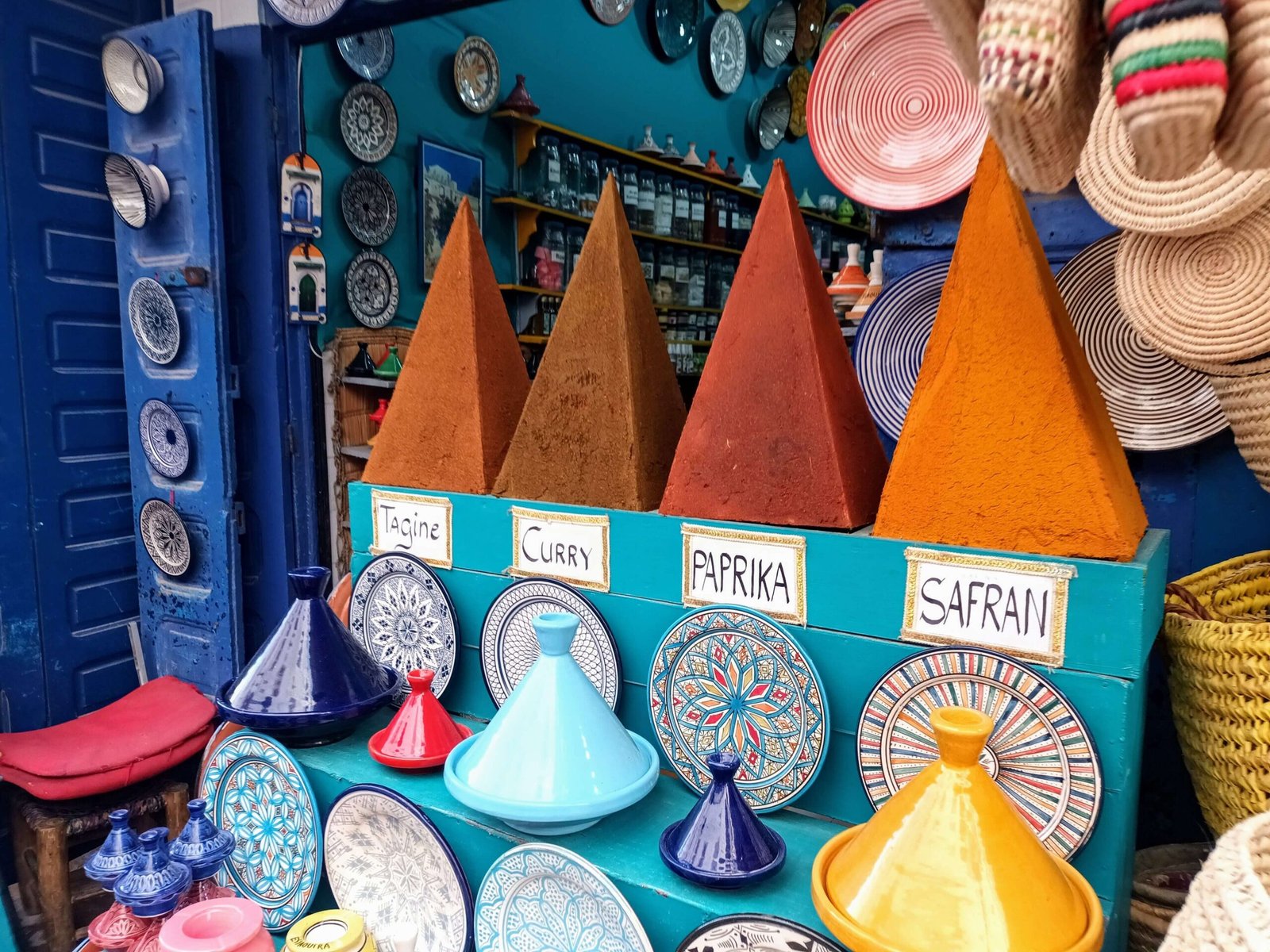
Pro-tip: Spices sold in mountains of colourful cones look great on Instagram but aren’t always the freshest; sealed containers from reputable stalls are a safer bet. Always smell before buying – good spices should be strong and aromatic.
Read: 17 Moroccan Food Facts You Didn’t Know
8. Rugs & carpets
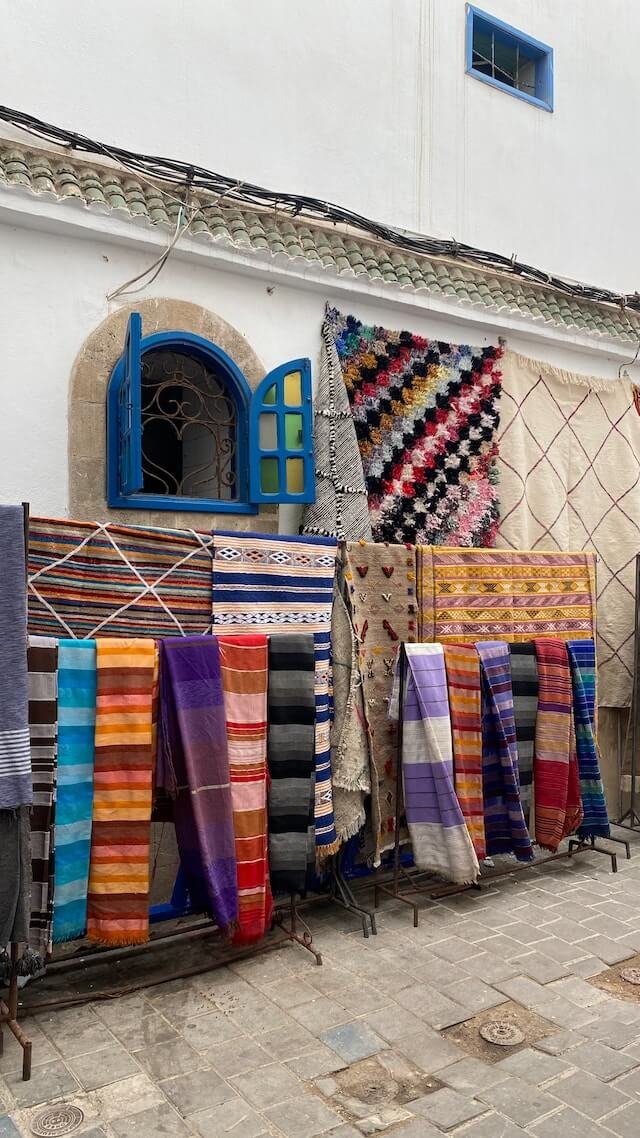
Moroccan rugs are one of the country’s most iconic crafts, and each piece carries entire histories of the tribes and regions that produced them.
Rug making in Morocco is a female-led craft dating back hundreds (if not thousands) of years.
In Berber culture, weaving was originally done at home on simple wooden looms, and the patterns you’ll see aren’t random: many symbols represent fertility, protection, femininity, mountains, rivers, or ancestral stories.
Buying a rug in Marrakech is a cultural ritual, complete with mint tea, lengthy descriptions of knot count and wool quality, and at least one dramatic demonstration of a rug being thrown open with a flourish!
Pro-tip: Don’t let baggage restrictions stop you from buying your dream rug: shipping is easy to arrange through most rug shops in Marrakech.
9. Leather goods
Moroccan leather, especially from the historic tanneries of Fez and Marrakech, is world-renowned. Craftsmen use natural dyes and traditional curing methods involving salt, lime, and plant-based ingredients.
In Marrakech, you’ll find leather pouffes, handbags, slippers, journals, belts, backpacks, and ust about anything else you can think of!
Pro-tip: Look for tight stitching and soft, even colouring. New leather may have a strong scent but don’t worry – that fades over time.
10. Sandals
Artisan shoemakers in Morocco handcraft sandals using thick leather and sturdy stitching. Styles range from minimalist brown straps to more decorative designs with colourful woven details.
Because they’re handmade, you can often have them custom-fitted or adjusted while you wait.
Pro-tip: Check the soles – they should be firm and durable, not flimsy.

11. Clothes
Traditional Moroccan clothing includes kaftans, gandoras, djellabas, and embroidered tunics in gorgeous colours and patterns. Many are made from cotton, linen, or light embroidered fabrics which are ideal for the hot weather.
You’ll find tonnes of clothing in the souks, but for trendier or higher-quality fashion, the Gueliz district is home to lots of independent designers who reinterpret traditional silhouettes in modern fabrics.
Pro-tip: In the medina, you should bargain, but in boutiques, the prices are fixed.
12. Mint tea & tea sets
Mint tea is a symbol of hospitality in Morocco, and you’ll be offered it in shops, riads, and even when buying carpets at 10 a.m.
Traditional teapots are made from brass or silver-plated metal and are designed for pouring from height to create the signature frothy top. Tea sets often include hand-etched glasses and a matching serving tray. Even if you don’t intend to prepare your own mint tea at home, they’re still lovely to have as decorative items or to give as a gift.
Pro-tip: If you’re planning to use your teapot to actually make the tea on the stove, your Moroccan teapot should be heat resistant. Ask the vendor if you’re unsure, as many Moroccan teapots sold in the souks are for decorative purposes, meaning you can use them to serve tea but not to make it.
13. Scarves
After travelling around Pakistan, I became a scarf convert. Scarves are so versatile – you can use them as a head covering, toss them over your shoulders to accentuate your outfit, or use them as an additional layer for the cooler evenings.
Scarves are worn year-round in Morocco, with lightweight cotton or silk blends for summer, and thicker scarves for cooler nights and desert trips.
Pro-tip: In the Dyers’ Souk, you’ll see artisans dyeing fabrics using natural pigments like indigo, saffron, and pomegranate peel. These make especially meaningful souvenirs.
14. Olive Oil
Olive oil production is deeply ingrained in Moroccan agriculture, especially around Meknes and the Atlas foothills. Moroccan olive oil is rich, peppery, and full-bodied.
Many cooperatives also produce flavoured oils infused with lemon, chilli, or herbs.
In my opinion, nothing beats a good olive oil, and you just can’t get it in UK supermarkets. Whenever I travel to a country known for its olive oil, I have to pick up a bottle!
Pro-tip: Look for cold-pressed, extra virgin, ideally in dark bottles to protect it from the sunlight. Although it might be tempting, don’t buy a huge tin – olive oil only lasts for around 3 months when exposed to the air, so smaller containers are better.
Read: The Growing Trend of Olive Oil Tourism
15. Amlou
Amlou is often described as ‘Moroccan Nutella,’ although it’s closer to almond butter mixed with honey and argan oil. It comes from the Souss region and is traditionally served for breakfast or with bread when welcoming guests. Amlou is one of my favourite things to eat in Morocco, and I really regret not buying any on my last visit!
Pro-tip: The flavour depends heavily on the quality of the argan oil, so for the best quality amlou, buy from cooperatives rather than tourist markets.
Read: 21 Traditional Moroccan Breakfast Foods

16. Tiles (Zellige)
Zellige tilework dates back to the 10th century and is still produced using painstaking manual techniques. Artisans cut small shapes by hand and assemble them into geometric mosaics seen in riads, mosques, and palaces. It takes an apprentice tile maker up to 10 years to be considered a true master of his craft!
While you probably won’t bring home an entire tiled fountain, coaster-sized tiles or small decorative pieces travel well and make high-quality souvenirs or gifts.
Pro-tip: Although you’ll find many tiles in the souks, it’s worth going to a ceramics workshop outside of the city walls to see the tile makers at work – not only is this a really special experience, but you can also be sure you’re getting the real deal.
17. Wooden boxes
If you wander around the souks, you’ll see dozens of vendors selling gorgeous wooden boxes with intricate patterns.
Moroccan woodcraft uses cedar, walnut, and thuya wood (which has a beautiful natural scent). Boxes are carved with geometric patterns or inlaid with bone, mother-of-pearl, or metal.

These boxes were traditionally used for storing jewellery, spices, or important documents.
Pro-tip: Examine your box closely before you buy. Make sure that lids fit properly and that the wood is smoothly finished.
18. Rose water & rose oil
Morocco’s rose-growing region, the Valley of Roses near Kalaat M’Gouna, produces some of the world’s most fragrant Damask roses. Every spring, entire towns celebrate the Rose Festival.
Rose water is used in cooking, skincare, and even laundry, while rose oil is far more concentrated and expensive – it takes thousands of petals to make a small bottle.
There are many benefits to incorporating rose water into your skincare routine. Used as a toner, it can soothe skin irritation, reduce redness, hydrate, and balance the skin’s pH due to its antioxidant, anti-inflammatory, and antibacterial properties. This makes it particularly effective for acne, eczema, and rosacea.
Pro-tip: Be cautious of synthetic products, which dominate the cheaper stalls.
19. Herbal medicines
Moroccan herbalists (attars) practice remedies that date back centuries.
Shops are filled with jars of dried herbs, eucalyptus crystals for congestion (these smell amazing), nigella seeds, saffron balms, natural deodorant stones, and remedies used in hammams.

Herbal medicine is intertwined with Amazigh traditions and Islamic healing practices, and the attar will usually explain what each remedy is believed to help with.
Pro-tip: Prices can vary wildly, so ask questions and take your time. Vendors in the souks will often intentionally add a bunch of things to your mixture and then try to charge the earth for it – be very cautious!

20. Olives
Moroccan olives are famous for their variety: lemon-cured green olives, spicy harissa olives, herby black olives, and garlic-stuffed variants. They’re sold loose in brine, and vendors will usually let you sample them first.
Pro-tip: Many stalls can vacuum-seal olives for travel, making them one of the easiest foodie souvenirs to bring home!
Shopping in Morocco: Tips & Etiquette
Bargaining is part of the culture
Haggling isn’t rude – it’s expected, and part of the culture. Souk sellers usually start high and expect you to negotiate. Start around one-third of the initial price and settle somewhere in the middle.
Be friendly and smile; aggressive bargaining won’t get you far.

Know when to bargain (and when not to)
Although bargaining is part of the culture in Morocco, it isn’t done everywhere.
If you’re in the souks, rug shops, or leather stalls, bargaining is fine. If you’re in a government cooperative, or nice boutique, expect fixed prices.
Take your time
In Morocco, shopping is social. Expect tea, conversation, and long explanations.
Rushing through is considered impolite, especially in artisan workshops.

Read: 23 Essential Marrakech Tips You Need to Know
Check product quality
• Look for ‘925’ on silver
• Ensure lamps have strong hinges and no dents
• Smell spices and oils before buying
• Check that wooden boxes close properly
• Examine stitching on leather
Respect local customs
• Ask before taking photos of people or their products – most vendors will not allow you to take pictures.
• Dress modestly when entering conservative areas.
• A firm ‘la shukran’ (no thank you) with a smile is the polite way to decline.
Carry cash
Many places do not accept cards, especially in the medina. ATMs can run out of cash on weekends, so withdraw earlier in the week.
Beware of ‘guides’
Men (and boys) offering to ‘show you around’ the medina will expect payment. Politely decline, and refuse to walk with them.
Where to Buy Souvenirs in Marrakech
1. The Medina & souks
This is where you’ll find the classic Marrakech shopping experience – chaotic, colourful, overwhelming in the best possible way.
There are many different souks (far too many to list in this article), and many of them are named after the products sold their – for example, Souk des Bijoutiers sells jewellery.

Souk Semmarine is one of the main souks that is very tourist-friendly. It’s great for clothes, leather slippers, ceramics, and more. Souk El Kebir is more traditional and less polished. Here you’ll find metalwork, lanterns, woodworking, and leather workshops tucked away behind the main lanes.
Souk des Teinturiers (Dyers’ Souk) is famous for its colourful yarns hanging above the streets. This area specialises in textiles, scarves, and naturally dyed fabrics.
2. The Mellah
Historically the Jewish quarter, The Mellah is still home to many jewellers. A great place for genuine silver and traditional Berber designs.
3. Ensemble Artisanal
A government-run artisan centre near Koutoubia Mosque. Prices here are fixed and products are made by trained craftspeople – this is the perfect spot if you hate bargaining or want guaranteed quality.
You’ll find leatherwork, woodcarving, ceramics, and jewellery.
4. Rahba Kedima (Spice Square)
This is a small open square just off Souk Semmarine and is one of the most atmospheric corners of the Medina. This is where you’ll find hundreds of spices and apothecary items. There are aesthetic pyramids of vibrantly coloured spices, dried rosebuds, argan oil, black soap, kohl eyeliner, herbal blends, and even cages of live chameleons and iguanas.
In the middle of the square, you’ll also find woven baskets, hats, and rugs.

5. Rue Mouassine & Rue Dar el Bacha
Trendy areas with curated boutiques offering modern Moroccan design. Think high-quality homeware, candles, textiles, and ceramics – perfect if you want artisanal items without the chaos of the souks.
6. Gueliz (New Town)
The modern district filled with concept stores, Moroccan fashion designers, and contemporary home décor. Prices here are higher but that’s to be expected. Great for clothes, jewellery, and design-led souvenirs.
7. Cooperatives (Argan oil, cosmetics, rose products)
Women’s cooperatives near Marrakech and throughout the Atlas Mountains produce argan oil, amlou, carpets, and cosmetics.
They offer transparency, fair wages, and reliable quality – worth the slightly higher price tag.
What to Buy in Marrakech | Final Thoughts
Shopping in Marrakech is unparalleled, and is one of the best things to do in Marrakech by far.
Not only can you find some wonderful products that you won’t find anywhere else, but the experience of shopping in Morocco is really something else.
I tried to be as in-depth as I could in this article, but if you’re planning a trip to Marrakech and have any questions, let me know in the comments section below and I’ll do my best to answer them.
Until next time,
XOXO
If you like this article and would like to support my work, please click the button above to donate a couple of bucks and buy me a coffee. The revenue that I receive on this website is minimal, so support from my readers enables me to keep creating content that you (hopefully!) love to read.
Disclaimer: Travelling Jezebel contains affiliate links. If you make a purchase on a recommended site, I may make a small commission at no extra cost to you.
